
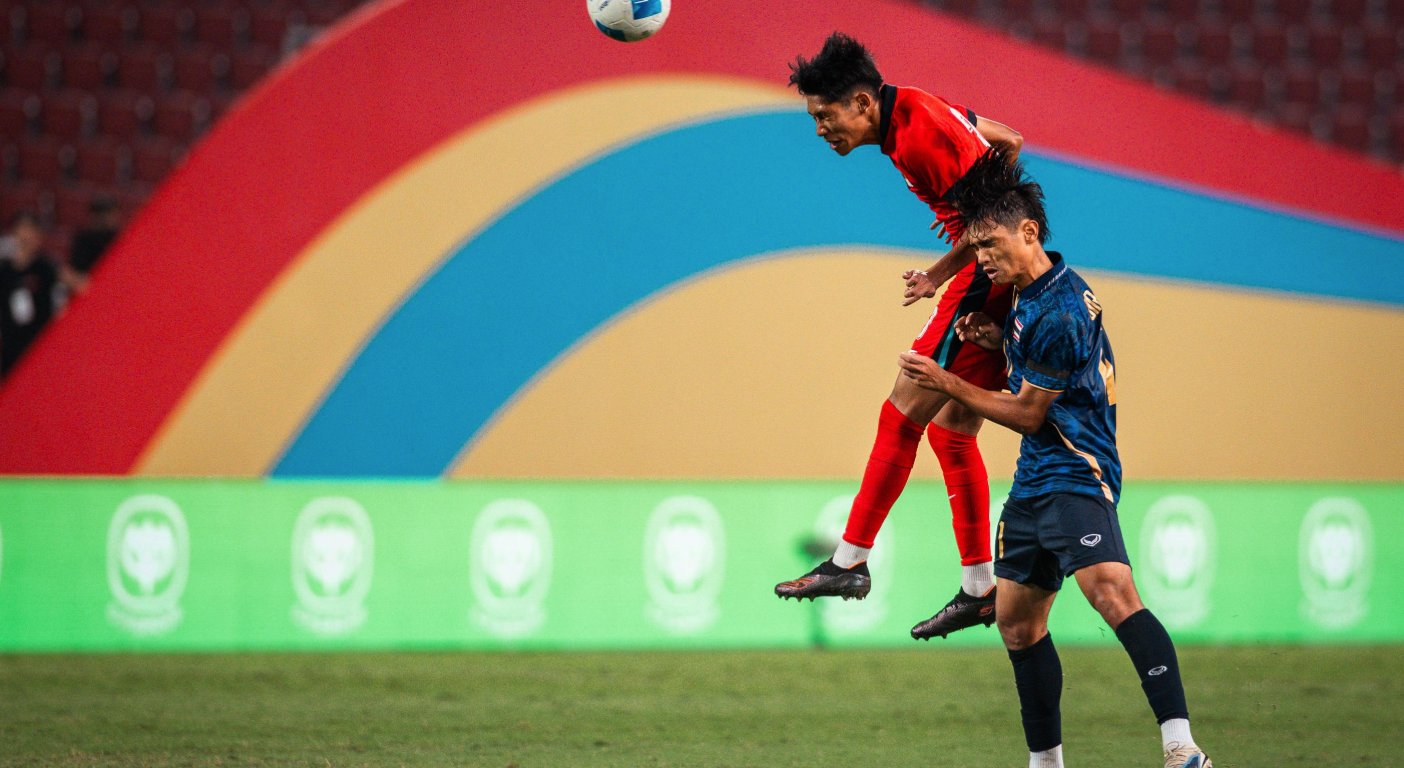

The Football Association of Singapore’s post-SEA Games press conference on 26th December at Jalan Besar Stadium was not so much an exercise in damage control as it was a belated attempt to realign expectations with reality.
Across an hour of explanation, data and reflection, led by a panel comprising Men’s U-22 National Team head coach Firdaus Kassim, FAS vice-president Tan Li Yu, council member Yeong Sheau Shyan and general secretary Badri Ghent, the central message from FAS officials and coaches was consistent: the disappointing results at the SEA Games were not unexpected internally, but the failure lay in not making that reality clear early enough.
Singapore’s men’s Under-22 team exited the tournament after defeats by Timor-Leste (3-1) and Thailand (3-0), while the women’s team lost to Indonesia (3-1) and Thailand (2-0). On paper, the results read as another setback. In context, FAS framed them as the predictable outcome of a youth development strategy still in its early stages. That gap between internal understanding and external perception emerged as the defining issue of the press conference.

Why was this level of detail about player limitations, experience gaps and developmental intent not shared before the SEA Games, so expectations could be managed more fairly? One might ask.
“We acknowledge, honestly, that the communication and expectation-setting for the SEA Games could have and should have come earlier,” FAS general secretary Badri Ghent said. “Internally, we were clear on what we were trying to do, but we accept that this wasn’t communicated clearly enough externally.”
Men’s Under-22 head coach Firdaus Kassim went further, explaining that transparency was not just a communications issue, but a developmental one. “We need to be honest from the start about where the players are,” Firdaus said. “Only then can we plan properly — not just as a team, but also in how the stories are told around the team, whether they are critical or something to celebrate.”
The acknowledgement marked a shift in tone from previous post-tournament debriefs, where explanations often followed criticism rather than anticipating it.

FAS vice-president Tan Li Yu described the SEA Games campaign as “not good enough”, with responsibility shared across management, staff and players. But he also stressed that the results must be read through the lens of deliberate long-term planning.
“This is the youngest team Singapore has ever sent to the SEA Games,” Tan said. “More than half the squad can play the next edition, and five of them are young enough to play again in 2029. That’s why we say it’s not all doom and gloom.”
That claim is borne out by the numbers. The men’s Under-22 squad at the 2025 SEA Games had an average age of just 19.78, the youngest Singapore team across five editions, down from 21.18 in 2022 and 20.8 in 2023.
The figures lend weight to Tan’s argument, but they also sharpen the contradiction at the heart of the campaign. A youth-first strategy inevitably carries short-term costs, particularly at a high-profile tournament like the SEA Games. “Youth development does not deliver results overnight,” Tan said. “It’s long-term planning, and the milestones don’t always align with major tournaments.”
The SEA Games, with its visibility and emotional weight, became the stage on which that contradiction played out most starkly.

Much of Firdaus’ presentation was aimed at dismantling a familiar narrative: that Singapore lacks talent. According to data shared by FAS, fewer than 15 players across the 2003 and 2004 age groups have accumulated meaningful first-team minutes, with only 13 players nationwide clocking more than 450 senior minutes across multiple age bands. “This is the starting point we must be honest about,” Firdaus said. “The issue is not talent alone. It’s experience.”
In contrast, players from regional rivals such as Timor-Leste, Thailand and Vietnam enter SEA Games tournaments having already accumulated thousands of professional minutes and international caps. “When you play in these tournaments, you’re not just playing an age-group competition,” Firdaus said. “You’re playing against players who have already been in professional environments for two or three years.”
The implication is clear: development cannot be compressed on demand, even with increased investment.

To address the experience gap, the new regime at FAS arranged an aggressive six-month programme of international fixtures leading up to the Games, including matches against Malaysia, the Philippines, Vietnam, Iraq, Iran, the UAE and a training camp in Portugal. “These games push the players out of their comfort zones,” Firdaus said. “It’s not about playing many games. But also about playing high-level opponents.”
The approach, he argued, was necessary even if it led to defeats. “If we don’t expose them to this level now, we’re only delaying the problem,” he said.
Firdaus also rejected suggestions that fitness was the key issue, pointing instead to inexperience and game management. “Our physical output matched regional benchmarks,” he said. “The difference is knowing how to manage moments in the game, and that only comes with experience.”

A similar theme emerged in the women’s programme. Council member Yeong Sheau Shyan said the performances against Indonesia and Thailand showed improvement, despite Singapore operating within an amateur framework. “In comparison, our players are studying or working full-time,” Yeong said. “Sometimes, it’s even difficult to train together regularly.”
Statistically, the women’s team was also the youngest it has fielded in three SEA Games cycles, with an average age of 22.4, down from 24.6 in 2023, and included a 16-year-old debutant in Seri Nurinsyirah.
That youth shift coincided with narrowing defeat margins against regional heavyweights. Losses to Thailand improved from 6-0 in 2024 to 2-0 at the SEA Games, while defeats to Indonesia narrowed from 5-1 to 3-1 over the same period. The data supports Yeong’s view that progress is being made, but also highlights the limits of what can be achieved without professionalisation and sustained overseas exposure.
Indonesia and Thailand, she noted, have professionalised their women’s leagues and invested heavily in overseas exposure, with Indonesia also benefitting from naturalised and foreign-based players.
Despite this, Yeong said FAS was encouraged by recent performances and pointed to structural changes ahead. A women’s committee formed in April is developing a strategic plan alongside global football platform UTR, with reforms expected in the coming months.

Badri also addressed public comments made by Singapore National Olympic Council (SNOC) secretary-general Mark Chay, clarifying that concerns over player conduct after the Timor-Leste match stemmed from a misunderstanding and had been resolved privately. “Mark’s comments came from a place of concern and care for Singapore football,” Badri said. “After our discussion, both of us felt positive about moving forward.”
The emphasis, he said, was on unity rather than public disagreement.“At the end of the day, between FAS, SNOC and other stakeholders, we are all here for the betterment of Singapore sport,” he said.

What the press conference ultimately revealed was not a lack of planning, but a failure to bring stakeholders along early enough. FAS has data. It has a pathway. It has young players and increasing international exposure. What it now needs is credibility built on transparency, not after results disappoint, but before expectations are set.
“If we want everyone to move forward together,” Firdaus said, “we need to be transparent about where we are, not just where we hope to be.”
The SEA Games may be over, but for Singapore football, the harder work, aligning reality, rhetoric and results, is only just beginning.
Photos courtesy of Football Association of Singapore
 WhatsThePlanPlease
Great article. thanks for going into detail and not just focusing on the snoc saga.
LikeLike
Thank you. Wishing you a blessed Christmas and a better 2026
LikeLike