
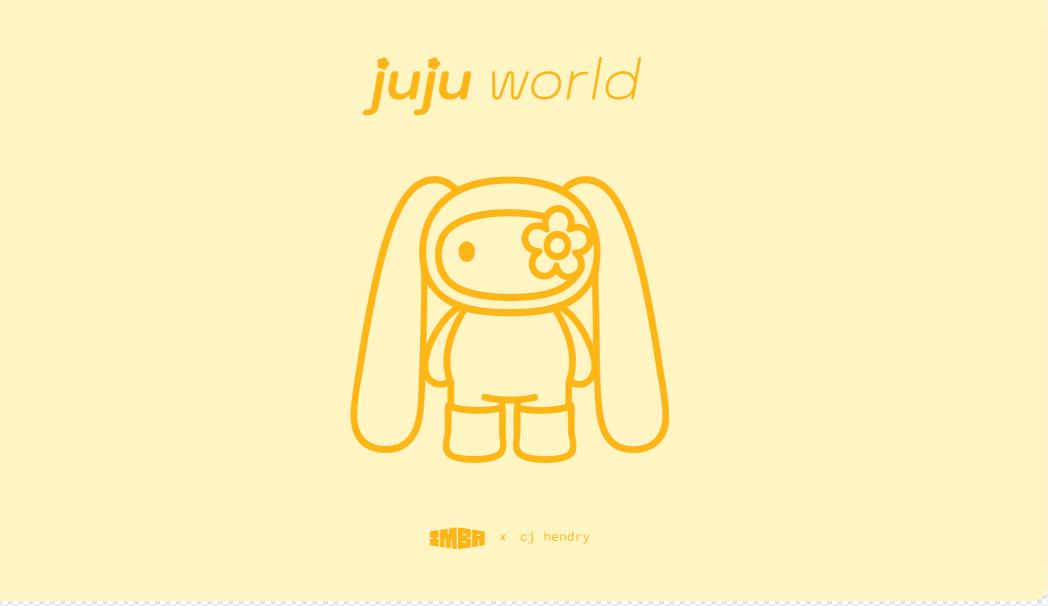

The first thing you notice about juju world is the overwhelming, oversaturation of yellow, so total it behaves like architecture. Yellow does not sit within the exhibition, it defines it. The space is flooded in it: staff dressed in yellow uniforms, inflatable yellow flowers erupting from the ground, and giant inflatable jujus attached to structures like climbable soft sculptures. Visitors move through oversized yellow slides that drop directly into a vast ball pit filled not with plastic spheres, but thousands of tiny yellow jujus. Even the merchandise architecture follows the same logic: rows of identical yellow metal blind boxes stacked with industrial repetition, turning collectibility into environment.
The effect is playful at first glance, but quickly becomes disorienting. The repetition of form, the absence of visual relief, and the scale of immersion create a space that oscillates between joy and unease. It is precisely this tension between accessibility and overload that has come to define Australian artist Cj Hendry’s work, and increasingly, the exhibition strategy of IMBA Theatre.

Hendry’s practice began as a rejection of distance, of the idea that art exists primarily as a scarce, privately owned object. Her early hyperrealistic drawings, often mistaken for photographs, were part of a quiet critique of exclusivity within the art market. But over time, that critique evolved into something larger: not just objects to be seen, but environments to be entered.
“I’ve been in the art world for many years, and there’s always been something that felt a little out of touch for me. Some of my artworks are valued at hundreds of thousands of dollars, which is great for collectors, but there was a disconnect. I’d make these drawings and they’d disappear into private homes, and that’s all people would ever see,” she said at the launch of juju world in Singapore.
“With Flower Market, the idea was to create something that lots of people could experience. There was absolutely no barrier to entry. I wanted to create something approachable, where people could come in, enjoy it, and even take something away for free. If people wanted to buy more flowers, great, but that wasn’t the goal.”
That shift proved decisive for IMBA. The recently concluded Flower Market became a mass-attendance cultural event rather than a conventional exhibition, with long queues, repeat visits, and intense social media circulation, not without its share of criticism and controversy. It demonstrated that experiential art could function simultaneously as cultural programming and visitor engine, an equation IMBA appears to have embraced and refined.

The success of these installations also comes with an unavoidable side effect: attention spirals beyond authorship. In Singapore, that dynamic was particularly visible. Visitors did not just experience the work, they documented it, debated it, and reinterpreted it in real time, and as Hendry puts it, “the response in Singapore has been the most extraordinary.”
Yet Hendry resists framing that attention as either problem or strategy, the subject of debate with how visitors hoarded the Singapore-exclusive flowers in bulk, often displaying unsavoury behaviour such as snatching them up and then reselling them online. Instead, Hendry treats it all as an inevitable consequence of scale and openness. “When something is successful and accessible, hype comes with the territory. We don’t go looking for hype. We focus on doing what we think is right, and whatever happens, happens.”
“After all, you can’t control everyone else’s narrative.”
That lack of control is part of what makes IMBA’s collaboration model interesting. The institution is not curating fixed meaning, but curating conditions under which meaning proliferates.

The most contested element of Hendry’s recent work is not its physical scale, but its origin. juju, the character at the centre of juju world, was developed through a process involving generative AI during early design stages, something Hendry has been unusually transparent about.
“Phillips Auction House asked me to design a toy and I said, ‘I don’t know how to design a toy. So I used AI. We probably went through 30 or 40 iterations. The first results were horrible. We kept refining them until something appeared that looked like juju, “she says. “I thought it was cute and friendly. It was partly a commentary on the Labubu phenomenon. We wanted to make something softer and friendlier.”
That origin has sparked debate in broader creative circles about authorship, originality, and the role of AI in contemporary art production. Critics question whether the use of generative tools undermines craft-based artistic labour, while supporters argue it reflects an increasingly hybrid creative landscape.
Hendry, however, remains consistent in her position: the work is not about defending process, but producing response. “As an artist, my job is to make you stop, whether that’s making you excited, angry, surprised, or thoughtful. I’m not here to please everyone.”
What is notable in the context of IMBA is not just the controversy itself, but how quickly it becomes part of the exhibition’s cultural gravity. The debate around juju’s origin did not suppress interest but amplified it, feeding directly into anticipation for the physical installation.

Inside juju world, that conceptual ambiguity becomes spatial reality. The character is repeated across scales and formats: inflatable sculptures, climbable installations, blind-box collectibles, and densely packed retail shelving units. The exhibition does not separate art object from commodity—it fuses them into a continuous environment.
At a media preview ahead of opening, that system was already functioning at full intensity. Visitors were purchasing multiple blind boxes at a time, priced at $39 each, or pre-ordering larger Jujus at $99. Others moved directly into merchandise consumption, purchasing tote bags, pins, fans, bottles, balloons, and keychains on offer.
The result is goes beyond footfall, and in fact, becomes a social experiment on consumerism and behavioural repetition: return visits, bulk purchases, and social circulation driven by scarcity and collectibility. IMBA, in this sense, is not just hosting an exhibition, but operating a structured attention loop.

Beneath the surface spectacle, juju world carries a more ambiguous visual logic. The repetition of identical figures, the uniform yellow palette, and the enclosed, maze-like environments produce an atmosphere that can feel strangely artificial, almost liminal and even vaguely unsettling through scale and sameness.
Whether this resonance is intentional or emergent is unclear. Hendry herself resists over-determining interpretation. “I think people sometimes get too deep into trying to explain everything,” she says. “One thing I don’t like in art is being told what to think. I don’t want to put a giant explanation on the wall and force people toward a particular interpretation. Maybe it’s a commentary on consumerism. Maybe that’s the point. Different people experience it differently.”
That interpretive openness allows multiple audiences to coexist within the same space: families treating it as playground, collectors as market, and digital audiences as content ecosystem.

What emerges from both Flower Market and juju world is not simply a successful artist-institution partnership, but a model for how cultural spaces operate in an attention economy. IMBA has not just found an artist who attracts visitors; it has found one who generates layered forms of attention: aesthetic, social, commercial, and controversial.
Hendry’s own description of her practice reinforces that logic of iteration and expansion. “I’m a very structured person. I believe creativity comes from constraints,” she says. “Constraint breeds creativity. Only through working really hard, being structured and diligent, have there been little glimmers of creativity here and there. I make a hundred mistakes. My studio makes mistakes all the time. We take missteps, but we’re always trying. Through constant iteration, we get better and better.” These final products came after years of making mistakes and refining ideas.”
In that sense, IMBA functions less as a traditional gallery space and more as a staging ground for iterative cultural systems, with works that evolve through repetition, participation, and public feedback loops.

The controversy surrounding Juju’s AI-assisted origins could easily have destabilised the project. Instead, it appears to have intensified it, folding into a broader narrative of accessibility, collectibility, and spectacle.
But for IMBA, this is the defining shift: cultural success is no longer measured solely in aesthetic terms, but in the ability to hold attention across multiple registers at once, even when that attention is contested.
And in that space between joy and discomfort, between play and consumption, juju world does something increasingly rare in contemporary cultural programming: it makes people show up, and then talk about why they did.
Featured Image Credit: IMBA
juju world opens from 20th June to 18th July 2026 at IMBA Theatre (Ticketed admission. Pre-registration is recommended, though walk-ins are welcome.) Join the IMBA Circle or follow @be.imba on Instagram for the latest updates on Cj Hendry at IMBA Theatre.

