
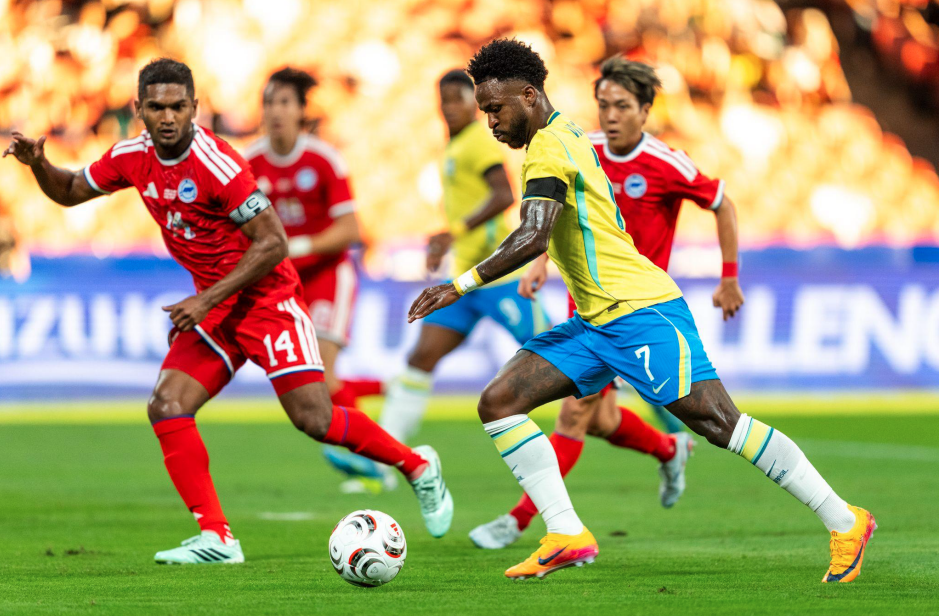
The inaugural Mizuho Blue Challenge – The Kallang Football Series Singapore came to an emphatic close at the National Stadium on Tuesday night, with Brazil scoring seven past Singapore before Paraguay edged Japan 2–1 in a match that marked the end of Hajime Moriyasu’s eight-year spell as head coach.
More than 72,000 fans attended the four matches across the tournament, which brought Brazil, Japan, Paraguay and Singapore together for a week of international football at The Kallang. The final doubleheader delivered goals, moments of promise for the home side and an emotional farewell for one of Asian football’s most recognisable coaches.
For Singapore, the challenge of facing Brazil proved as formidable as the scoreline suggested. Vinícius Júnior scored a first-half hat-trick, with Endrick adding another before the break, as the visitors demonstrated the gulf in pace, quality and experience between the sides. Brazil continued after half-time, scoring three more through Estêvão, Rayan Rocha and substitute Allan Elias to complete a 7–0 victory.
The second match was a different kind of contest. Japan, playing Moriyasu’s final game in charge, fell behind early to Paraguay and struggled to find a way through a disciplined defence. A late goal from substitute Shio Fukuda gave the Samurai Blue hope, but Paraguay held on to finish their Singapore campaign with a 2–1 win.

There was something unusual about the scene at the National Stadium. The sun was still out as the teams took to the pitch, but the stadium roof was already closed, setting the stage for Singapore’s meeting with one of world football’s most celebrated sides.
Before kick-off, players and supporters observed a minute of silence in memory of Dino Sani, a member of Brazil’s first FIFA World Cup-winning squad.
With head coach Carlo Ancelotti watching from the stands while serving a suspension following his red card against Japan, Brazil wasted little time getting into their rhythm. Vinícius Júnior opened the scoring in the ninth minute, turning his marker inside the penalty area before finding the net to put the visitors ahead.
Singapore had moments when they looked willing to take the game to their opponents, but Brazil’s ability to turn possession into dangerous transitions quickly became apparent. The second goal in the 15th minute was a demonstration of that difference. Winning the ball in their own half, Brazil moved forward at pace, with Vinícius combining with Endrick before the Real Madrid forward finished to make it 2–0.
Vinícius completed his hat-trick in the 21st minute, leaving Singapore with a difficult task before the match had even reached its halfway point. Brazil continued to find space and punish openings, and Endrick added his second of the night in the 31st minute to make it 4–0.
Yet Singapore were not simply content to defend and watch the game pass them by. They continued to look for opportunities to attack, and one of their better moments came in the 35th minute. Ryhan Stewart did well to get back ahead of his marker down the flank before delivering an inviting cross for Ilhan Fandi. The forward had a chance to turn it into a goal, but could not make the most of the delivery.
It was a reminder that, even against opposition of Brazil’s calibre, Singapore could create moments of danger when they moved the ball forward with purpose. The difficulty was sustaining those moments against a side capable of exploiting even small gaps.
Brazil resumed after the break with the same attacking intent. Estêvão scored in the 51st minute to make it five, before Rayan Rocha added a sixth in the 65th minute following a swift breakaway. Substitute Allan Elias completed the scoring in the 74th minute, taking the score to 7–0.

Singapore also had a penalty appeal reviewed by VAR, but the decision went against the home side. With both teams making changes and giving players from the bench an opportunity to feature, the match gradually moved towards its conclusion without further goals.
The result was a heavy one, but Singapore’s approach was not simply to sit back and absorb pressure. The Lions tried to play their game and had opportunities to make the evening more competitive, even if the difference in experience and individual quality was ultimately too great.
Head coach Gavin Lee acknowledged the lessons that would come from the match, but also looked beyond the immediate result to the effect such an occasion could have on younger players watching from the stands.
“When we evaluate the game, we can take clearer lessons from it,” he said. “But at the same time, like I was telling the boys, these kinds of matches are not just for us. They’re for the next generation of players as well.”
Lee said seeing local players compete against global stars could give young Singaporeans something to aspire to.
“For them to see their local heroes go up against their global heroes is definitely exciting, and it should inspire them. Sometimes we have to take the brunt of it, but hopefully the next generation can say, ‘I want to be in their shoes one day. I want to go and play Brazil as well.’”
For Brazil, the result provided a positive end to the November international window. Assistant coach Francesco Mauri, who spoke in place of the suspended Ancelotti, said the team had wanted to finish the period on a high before the next international window in March.
He was pleased with the way Brazil had performed with the ball, both against Japan and Singapore, but also identified areas that still needed attention.
“It’s not just the result,” Mauri said. “Against Japan, I think we also did really well with the ball, and tonight too. But we have to improve because, without the ball, even tonight, sometimes we pressed at the wrong time.”
The seven-goal performance was an emphatic way to finish the trip, but Mauri’s comments reflected a team still looking to refine its approach rather than judge its progress on the scoreline alone.

The second match of the night carried a different significance. Japan were playing their final game under Moriyasu, who was stepping down after eight years in charge, and the occasion brought an emotional atmosphere to the National Stadium.
But Paraguay had little intention of allowing the farewell to become a celebration on the pitch.
They took the lead in just the second minute when Juan Cáceres found the net with a volley, giving Japan an immediate setback. Paraguay’s physical presence and willingness to attack set pieces made life difficult for the Samurai Blue, who were forced to chase the game from the opening stages.
Japan tried to respond through possession and movement, but Paraguay remained organised and difficult to break down. Their defensive discipline was matched by their threat from dead-ball situations, and they doubled their advantage in the 40th minute when Gustavo Gómez rose to score from a corner.
The goal gave Paraguay a two-goal lead at the break, although Japan had a major talking point just before half-time. The home of the Samurai Blue? No — Japan believed they had earned a penalty following a handball appeal, but after a VAR review the referee decided against awarding the spot kick. Junnosuke Suzuki was shown a yellow card instead.
Japan returned for the second half knowing they had to find a way back into the match. They pressed forward and made changes in search of a breakthrough, but Paraguay continued to defend with discipline, limiting the clear opportunities available to their opponents.
The Samurai Blue did eventually find a way through in the 85th minute. A Kubo free kick was palmed into the path of the onrushing Shio Fukuda, who headed the ball into the net to reduce the deficit to 2–1.
The late goal gave Japan a final push, and they continued to search for an equaliser through four minutes of stoppage time. Paraguay, however, held their shape and saw out the remaining minutes to secure the win.

For Alfaro, the result was built on a familiar strength: Paraguay’s ability to defend well and make their opportunities count. Both goals came from corners, reflecting the work that had gone into their set-piece routines. The coach explained afterwards that Paraguay had deliberately varied their movements and crowded the penalty area to make Japan uncomfortable.
He also praised Japan’s quality, describing them as one of the 10 or 12 best national teams in the world. In his view, Japan had not necessarily lost because they had played badly; rather, football can be decided by key moments, and Paraguay had been more efficient when those moments arrived.
Paraguay’s defensive organisation was another important factor. Alfaro believes his side have developed one of the strongest defensive units in international football, and the way they managed Japan’s attacking transitions helped them protect their lead even as the Samurai Blue pushed forward.
The victory was a fitting end to a significant year for Paraguayan football. After returning to the World Cup following a long absence, the team have been working to build confidence and establish themselves as a side capable of competing against the strongest nations.

For Alfaro, the progress made in 2026 should be viewed as a foundation rather than a finishing point. He said the team had travelled to Singapore with the intention of giving their country something to be happy about, particularly amid difficulties at home.
“As we told the players before coming here to Singapore, and given all the problems that have come up in Paraguay itself, we wanted to give the people something to be happy about,” he said. “We knew the only thing we could do and the only thing we knew how to do was to play football, and we committed to representing the country well in that sense.”
He described the year as historic, but was clear that the team’s ambitions extended further.
“So for me, a beautiful year is ending, a historic year. And for me, it’s far from the ceiling we’re aiming for. This is the platform, the starting point for what we want to achieve.”
Alfaro also called for the wider Paraguayan football community to work together, stressing that the national team was a product of the country’s broader football development. The progress made by the senior side, he said, would need to be supported by collective effort if Paraguay were to take the next step.
The Japan match provided a useful measure of that progress. Alfaro acknowledged the Samurai Blue’s technical quality and improvement over recent years, while also identifying areas his own team must continue to develop, particularly keeping possession under pressure and dealing with the tempo of opponents whose players regularly compete in Europe.

While Paraguay celebrated their victory, the final whistle brought an emotional end to Moriyasu’s time in charge of Japan.
After eight years at the helm, the coach leaves having overseen a significant rise in the national team’s standing. Japan climbed 38 places in the FIFA World Ranking during his tenure to reach 17th, and his final match was marked by banners from supporters thanking him for his service. There were also emotional scenes among the players after the game.
Moriyasu took responsibility for the defeat, pointing to the early goal and Paraguay’s effectiveness from set pieces as key factors. He said Japan needed to raise their level and play more aggressively, but refused to use limited preparation time or disrupted training as an excuse.
He also thanked the players for continuing to fight until the end, and expressed his appreciation for the support shown by fans throughout his time with the national team.
Asked about his legacy, Moriyasu was reluctant to make the occasion about himself. Instead, he placed his work within the longer history of Japanese football, acknowledging the coaches and players who had helped build the foundations before him.
“It does not really matter how people remember me as a coach,” he said. “I am just part of the long history of the football family in Japan. It is all because of the people from the past. Like in athletics, I received the baton from former coaches and players. I am just part of that history, so it does not really matter to me how I will be remembered.”
He has previously spoken about wanting Japan’s progress to give supporters across the country, and the wider Asian football community, confidence that the continent can compete with the world’s leading nations. He believes the standard of Japanese football has risen and that the country has the potential to become one of the top football nations in the world.
Moriyasu rated his eight-year tenure seven out of 10, reflecting his disappointment at not achieving all the results he had hoped for, particularly at the World Cup. Nevertheless, he believes Japan showed they could compete on the biggest stage.
It was a fittingly modest reflection from a coach who repeatedly emphasised that the national team’s progress was larger than any one individual.
The final doubleheader brought an end to the inaugural Mizuho Blue Challenge – The Kallang Football Series Singapore, which opened on 13 November with Paraguay defeating Singapore 4–1.
Japan then produced one of the tournament’s standout results by beating Brazil 3–2 the following night, before Brazil responded with their seven-goal performance against Singapore. Paraguay’s victory over Japan completed the four-match programme.
Across the week, more than 72,000 fans came through the National Stadium to watch the four national teams compete. There were heavy defeats, memorable goals, a major upset and an emotional farewell, but the series also offered Singapore supporters the chance to see some of the world’s leading players on home soil.
For the Lions, the challenge of facing Brazil and Paraguay offered a demanding measure of the work still required to close the gap with established international sides. For Japan, the tournament ended with the departure of a coach who had overseen a period of considerable progress. And for Paraguay, the final victory provided another reason to believe in the direction of their project as they look towards the World Cup.
The scorelines told only part of the story. The week at The Kallang was also about exposure, ambition and the possibility of what international football can inspire across the region.

