
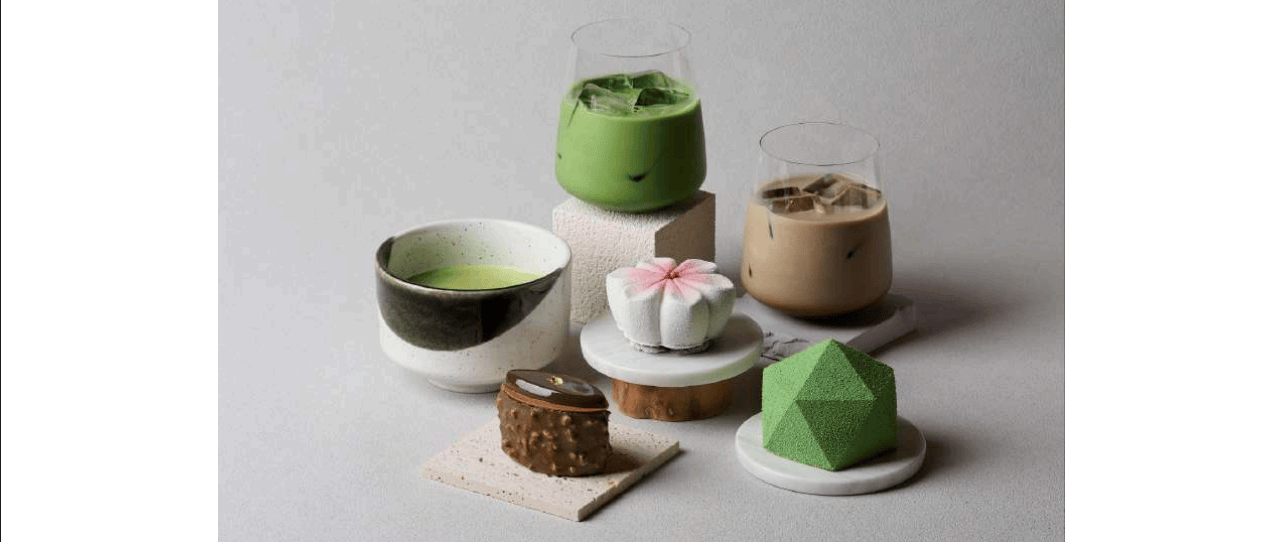

Before matcha became a global obsession, it was simply tea, shaped by landscape, weather, cultivation and generations of hands. At KOKO Kawane, that long history is now being brought to Singapore in a setting designed to make Japanese tea feel less like a trend and more like a daily ritual.
Opened at The Star Vista, KOKO Kawane is a new tea and matcha-specialty atelier built around the tea-growing heritage of Kawane in Shizuoka. The concept brings together KOKO, the Japanese-style patisserie concept owned and managed by GAIA Group, and Kawane Matcha, a family-run tea farm whose history stretches back more than 400 years.
At the centre of the collaboration is the Ohashi family, now in its 13th generation. For centuries, the family has cultivated tea in the mountainous Kawane region, where elevated terrain, misty conditions, natural springs and mineral-rich soil create a slower-growing environment that allows the leaves to develop greater complexity and aroma.
KOKO Kawane aims to bring that story from farm to cup, pairing teas grown in Kawane with handcrafted cakes and pastries created by Head Pastry Chef Mei Kubota, who combines Japanese ingredients with French pastry techniques.
“KOKO Kawane reflects our belief that a meaningful dining experience begins with a strong connection to its origins,” said Chai Karim, Principal of Gaia Lifestyle Group. “Working directly with Kawane Matcha allows us to share far more than just what’s in the cup. We can introduce guests to the people, place and generations of knowledge behind it. We hope KOKO Kawane becomes somewhere guests can pause, learn and develop a deeper appreciation for Japanese tea in a way that feels warm and accessible.”

Kawane sits along the Ōi River in Shizuoka, Japan’s largest tea-producing region. The region accounts for roughly 40 per cent of Japan’s tea output, while Kawane itself contributes only around 2.5 per cent — a distinction that speaks to the area’s focus on smaller-scale, carefully cultivated tea.
The Ohashi family’s relationship with the land dates back to the 1600s. Today, 13th-generation owner Kazuteru Ohashi continues to care for the family’s fields, adapting cultivation according to the individual conditions of each plot and each harvest.
“For more than 400 years, my family has cared for these fields with respect for the land and for the knowledge handed down through each generation,” said Ohashi. “Through KOKO Kawane, I hope guests in Singapore can experience the character of Kawane tea and understand the care behind every cup. It is a meaningful way to carry our family’s work forward and share it with a wider audience.”
That emphasis on provenance is reflected throughout the atelier. Rather than simply offering a menu of matcha drinks, KOKO Kawane encourages guests to notice how different cultivars and preparations change the flavour of the tea.

For those who like their matcha with milk, three expressions are available as lattes. The single-origin Okumidori ($13.50) is full-bodied, with pronounced umami and a naturally sweet finish. The signature Soemon Blend ($12.50) combines Okumidori, Tsuyuhikari and Yabukita cultivars with other first-flush tea leaves, resulting in a creamy, silky profile with notes of dashi, nut butter and cream.
The House Blend ($8.50) is lighter and more refreshing, balancing umami with gentle bitterness. There is also a medium-roast Hojicha Latte ($8), with warmer notes of hazelnut, malt and light cocoa.
Lattes can be served hot or cold with dairy or oat milk at no additional charge. They are sweetened with raw cane sugar by default, although guests can request them without sugar.
For a more traditional experience, the atelier serves usucha, or “thin tea”, where matcha is whisked directly with water. Tsuyuhikari is crisp and refreshing with subtle sweetness, while Okumidori offers deeper umami and a smooth finish. Both are $7 and can be served hot or cold.
The dine-in Usucha Flight ($17) takes the comparison further, bringing together Tsuyuhikari, Soemon Blend and Okumidori in one sitting.
Other teas include Karigane Hojicha, made by roasting premium tea stems, stalks and leaves, and Kasuga Hojicha, a fuller leaf-roasted tea with deeper caramel and nutty notes. Fukamushi Sencha, meanwhile, undergoes a longer steaming process that produces a fuller-bodied cup with a smooth, rounded mouthfeel.

One of the more distinctive touches at KOKO Kawane is that part of the production process happens right in front of guests.
The atelier’s Daily Micro-Mill uses a specialised stainless-steel Hibiki grinder, designed for precise calibration and low-heat milling to help preserve the tea’s aroma, colour and flavour.
Matcha begins life as tencha, or, shaded tea leaves that are steamed and dried before being ground into powder. For an additional $1, guests can order the Freshly Ground Matcha of the Day, with a rotation of Okumidori, Tsuyuhikari or Soemon Blend milled from tencha just before preparation.
The process takes around 10 minutes, turning what is usually an invisible step in the journey from farm to cup into something guests can actually watch.
It is a small but telling detail. At KOKO Kawane, the intention is not simply to serve a beautifully made drink, but to make some of the craft behind it visible.

The tea story continues onto the pastry counter, where Chef Mei Kubota translates Kawane’s fields, harvests and natural surroundings into a collection of Japanese-French creations.
Midoba ($10) takes the shape of a fresh tea leaf, layering almond sponge with matcha crémeux, raspberry jam and matcha crunch. Matcha chocolate and hazelnut coating surround the pastry, while matcha and raspberry ganache and delicate “dew drops” evoke the freshness of a spring harvest.
Kohaku ($10) looks towards autumn, combining hojicha almond sponge, hojicha crémeux, hazelnut praline and passionfruit jam on a hazelnut crunch base before being finished with hojicha chocolate and ganache.
Kirizakura ($12), shaped like a white cherry blossom, references the morning mist that settles over Kawane’s mountain tea fields. Inside are light hojicha mousse and a peach compote centre, set over hojicha almond sponge and black sesame crunch.
Akane ($12) draws inspiration from twilight over the shaded tea fields, pairing coconut mousse, mango compote, matcha crémeux and matcha sponge. The signature Hisui ($14) brings together matcha mousse, hazelnut praline crunch, strawberry jam and matcha sponge.
There is also a more traditional route into the pastry collection through ochagashi, the Japanese practice of pairing tea with a small confection. At KOKO Kawane, Tsuyuhikari is paired with Akane, while Okumidori comes with Kohaku. Each pairing is $15.
Selected teas are available to take home too, including first-flush Tsuyuhikari and Okumidori from the 2026 harvest at $45 each, Soemon Blend at $40 and Hojicha at $20. A gift set containing the three matcha expressions is priced at $115.
The 15-seat atelier is designed as a quiet counterpoint to the bustle outside. Soft, warm lighting meets natural light from floor-to-ceiling windows, while the curved counters and tables take inspiration from the undulating terrain of Kawane’s mountain tea farms.
Guests can watch the tea baristas prepare their drinks, browse the retail selection or observe the pastries through the display. An interactive tea station offers a closer look at harvesting and tea production, while a custom 3D landscape model depicting the Ohashi family home and surrounding tea fields serves as the space’s focal point.
It reinforces what makes KOKO Kawane interesting: the experience is not only about drinking matcha, but about understanding where it comes from.
In an era when matcha can sometimes feel detached from its origins, KOKO Kawane puts the landscape back into the conversation. Four centuries of farming history may be a long way from a shopping mall in Singapore, but here, the journey from those mountain fields to the cup is deliberately made part of the experience.
KOKO Kawane
#01-02, The Star Vista
1 Vista Exchange Green
Singapore 138617
Open daily, 10am–9pm
Last orders: 8.30pm
Tel: +65 8209 7988

