
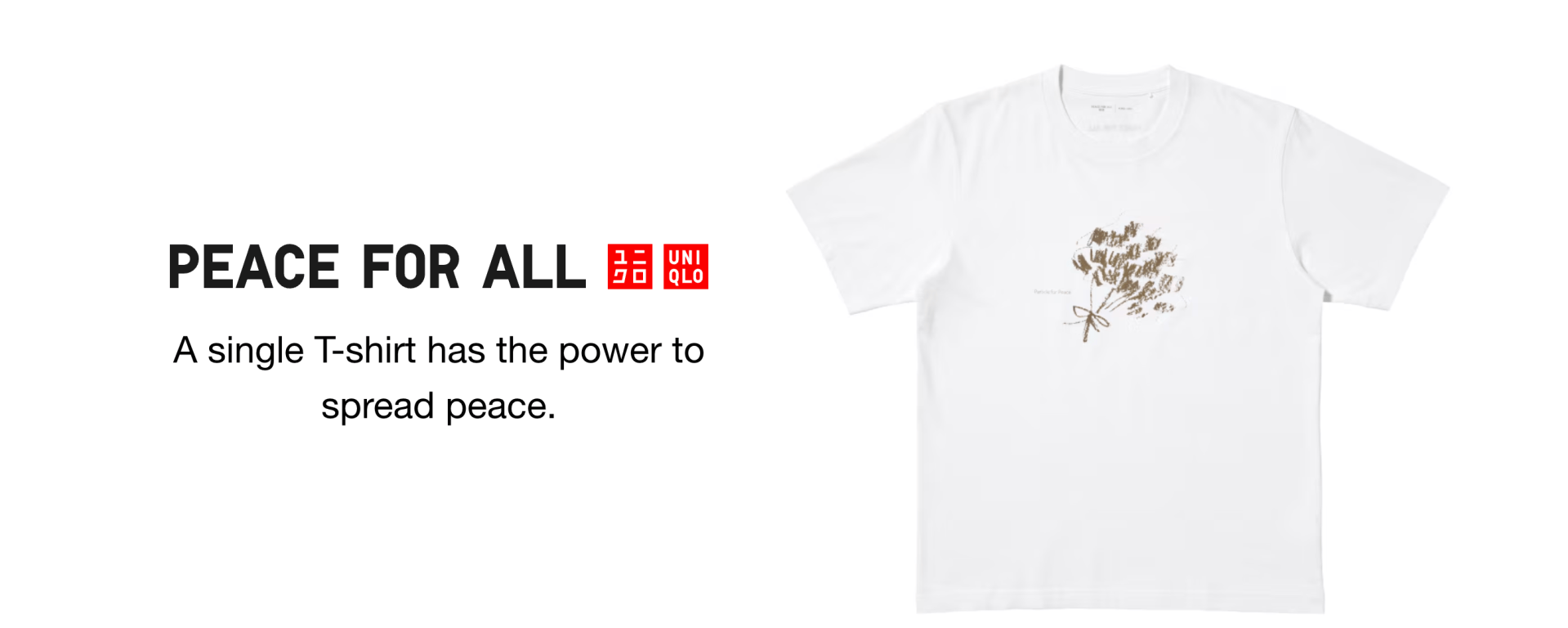
With a new design by Japanese architect Kengo Kuma and more than US$21 million raised globally, UNIQLO’s PEACE FOR ALL project is a reminder that the smallest everyday choices can contribute to something much bigger.
A T-shirt is one of the most ordinary things in our wardrobes. It is something we reach for without much thought, an everyday essential that crosses generations, cultures and personal styles. Yet, in the right hands, even a simple garment can become a vehicle for a larger message. For UNIQLO, that message is peace, and its PEACE FOR ALL initiative is built around the belief that something as familiar as a T-shirt can help bring people closer to a more hopeful future.
Launched on 17 June 2022, the global charity project invites artists, designers, architects, athletes and other influential figures to contribute original T-shirt designs expressing their wishes for world peace. The campaign’s rallying cry is simple: “A single T-shirt has the power to spread peace.” Each design offers its creator a way to communicate a personal perspective, while each purchase gives customers an opportunity to participate in a collective act of support. As the campaign puts it, “It’s time for action, in the name of world peace.”

The idea has resonated with customers around the world. According to UNIQLO’s activity report, PEACE FOR ALL had raised US$21.5 million from T-shirt sales as of 31 July 2026, based on a total of ¥3.459 billion in donations. At a special event in Singapore on 12 October, speakers cited a subsequent milestone of approximately US$22.2 million, reflecting the project’s continued growth. Beyond the numbers, however, the gathering offered an opportunity to consider what these contributions mean for the people and communities receiving support.
Among the latest collaborators lending their creative voice to the initiative is Japanese architect Kengo Kuma, whose work has long explored the relationship between materials, nature and the spaces people inhabit. His participation brings a design-led perspective to a project that seeks to make an abstract ideal tangible, translating the idea of peace into something people can wear, share and incorporate into their daily lives.
Kuma’s PEACE FOR ALL design, titled Particle for Peace, features a hand-drawn bouquet. The imagery offers a gentle visual expression of togetherness, suggesting that individual elements can retain their own character while contributing to a larger whole. It is an idea that resonates with the broader ambition of the campaign: a peaceful world need not be one in which everyone is alike, but one in which differences can coexist with mutual respect and understanding.

Although Kuma was unable to attend the Singapore event in person, his contribution formed part of a wider conversation about the role of creativity in encouraging social change. His design also sits within a diverse collection of PEACE FOR ALL collaborations, bringing together voices from fields as varied as architecture, photography, film, sport, literature and art. The common thread is not a single aesthetic, but a shared willingness to use creative expression to communicate a hope for peace.
For UNIQLO, the project is an extension of its LifeWear philosophy, which centres on making everyday clothing that improves people’s lives. At the event, Yukihiro Nitta, Fast Retailing Group Executive Officer for Sustainability, explained how this thinking extends beyond the person wearing a garment. Through PEACE FOR ALL, he suggested, customers can become part of a wider effort to support people facing poverty, discrimination, violence and conflict.
The model is deliberately straightforward. Collaborators volunteer their designs, customers purchase the resulting T-shirts, and the profits are channelled towards charitable organisations working on humanitarian and social issues. UNIQLO’s parent company, Fast Retailing, donates an amount equivalent to the profits generated by the charity T-shirts, with the international programme supporting organisations including UNHCR, Save the Children Japan and Plan International. The project has also established local partnerships, allowing its work to respond to the needs of communities in individual markets.
In Singapore, the initiative supports Community Chest, which works with social-service agencies across a range of causes, as well as organisations including Allkin and Fei Yue. For every PEACE FOR ALL T-shirt sold in Singapore, 20 per cent of the selling price is donated to Community Chest to support lower-income families and people affected by violence. These local partnerships are especially significant because they connect a global campaign to needs that exist much closer to home.

The event’s panel discussion brought some of these realities into focus. Representatives from Save the Children and Singapore’s social-service sector spoke about the challenges confronting vulnerable children and families, from poverty and displacement to domestic violence, abuse and mental-health difficulties. Their accounts challenged the assumption that peace is simply the absence of war, highlighting instead the everyday conditions that allow people to feel safe, develop their potential and participate meaningfully in society.
Speaking on behalf of Save the Children, a representative working with the organisation’s Thailand team described its mission as ensuring that every child, regardless of circumstance, has the opportunity to learn, grow, be well and be safe. It is a deceptively simple ambition, but one that can be difficult to realise when families face several interconnected pressures at once. Poverty can restrict access to education, healthcare and adequate nutrition, while displacement, climate-related disasters and economic instability can further undermine a household’s ability to provide a stable environment for its children.
The representative illustrated these challenges through the experience of low-income communities in Bangkok, where families may already be struggling to make ends meet when flooding damages their homes or prevents them from working. Such events can have consequences that extend well beyond the immediate loss of income, placing additional pressure on children’s education, wellbeing and sense of security. Yet the discussion was not defined by hardship alone. “At Save the Children, we see consistently, no matter where a child is, children and young people are incredibly resilient,” the representative said, emphasising the importance of safe spaces, adequate resources and opportunities for young people to participate in decisions affecting their lives.

That emphasis on participation is particularly relevant to the organisation’s youth-development work in Bangkok, where young people from underserved communities receive vocational training, life-skills development, career guidance and opportunities to experience the workplace. Through its partnership with UNIQLO, the programme also involves store visits and career-inspiration activities led by employees. These encounters can help young people become more confident about navigating unfamiliar environments and considering possibilities they may not previously have imagined for themselves.
One of the most encouraging outcomes discussed at the event was the prospect of programme graduates returning as mentors to support the next group of participants. It is a small but meaningful indication of how opportunities can create their own momentum. Young people who have benefited from guidance and encouragement can, in time, offer that same support to their peers, extending the programme’s influence beyond its initial participants.
The conversation also turned to Singapore, where the appearance of prosperity can sometimes obscure the difficulties faced by vulnerable families. Domestic violence, child abuse and mental-health challenges do not always take visible forms, and stigma can make it harder for those affected to seek help. The Singapore-based speaker highlighted the importance of recognising what may remain unseen, particularly when children are living with experiences they may not have the words or emotional resources to understand.

For Fei Yue, whose HEART@Fei Yue Child Protection Specialist Centre provides casework, therapy and preventive programmes for children and families facing child-protection concerns, the work begins with helping children feel safe enough to process difficult experiences. Abuse can affect how children see themselves, how they learn to trust others and how they understand the world around them. Through age-appropriate approaches such as art and play therapy, children can begin to work through those experiences in an environment designed around their needs.
The importance of this work extends beyond immediate intervention. Children need consistent, caring adults and supportive environments in which they can rebuild confidence and develop healthier relationships. As the panel discussion made clear, improving a child’s circumstances involves more than responding to a crisis; it also means creating the conditions for recovery, growth and a more secure future.
These examples give the idea of peace a more intimate meaning. It can mean a child having somewhere safe to turn, a young person discovering a possible career path or a family receiving support at a moment when everyday life becomes difficult to manage. Such outcomes may seem far removed from the purchase of a T-shirt, but they are precisely what the project’s network of charity partners seeks to make possible.
The initiative’s broader philosophy rests on the idea that no single individual or organisation can bring about meaningful change alone. Designers contribute their creativity, customers make the purchases that generate donations, and charitable organisations bring the local knowledge and expertise needed to direct that support. When these efforts come together, an ordinary transaction can become part of a longer-term relationship with communities and the people working to support them.

There is also a meaningful connection between this collective approach and Kuma’s Particle for Peace design. Just as individual elements can form a larger composition without losing their distinct identities, the PEACE FOR ALL project brings together people with different skills, backgrounds and perspectives around a common aspiration. Its strength lies not in asking everyone to contribute in the same way, but in creating a shared purpose to which each participant can add something.
The ambition now is to deepen that impact, rather than simply increase the scale of the initiative. At the Singapore event, the discussion centred on responding more closely to local needs, strengthening relationships between collaborators and beneficiary communities, and building partnerships that can endure beyond a single campaign. It is an acknowledgement that raising funds is only one part of the process; the lasting value lies in how those funds are used and the opportunities they help create.
Ultimately, a T-shirt cannot resolve the complex causes of poverty, violence or inequality, and charitable giving is no substitute for the sustained work of humanitarian organisations and local communities. But a project such as PEACE FOR ALL offers a way for people to participate in that work through an everyday choice. It creates a connection between the clothes we wear and the lives of people we may never meet, reminding us that the objects we bring into our wardrobes can carry meaning beyond their design or function.

For Kuma, the language of a bouquet offers one expression of that hope; for the charity partners, it is found in the practical work of helping children feel safe, giving young people greater independence and supporting families through difficult circumstances. Both perspectives return to the same underlying idea: a more peaceful world is built through the relationships we nurture and the actions we take, however small they may seem.
The next time a T-shirt becomes part of a daily routine, its significance might therefore extend a little further than the person wearing it. Through PEACE FOR ALL, UNIQLO is making the case that peace need not remain an abstract ideal. It can begin with an individual choice, gather momentum through collective action and, with sustained effort, contribute to a world in which more people have the opportunity to live safely and with dignity.
Find out more about UNIQLO’s PEACE FOR ALL initiative here. Shop the new Kengo Kuma design here

