
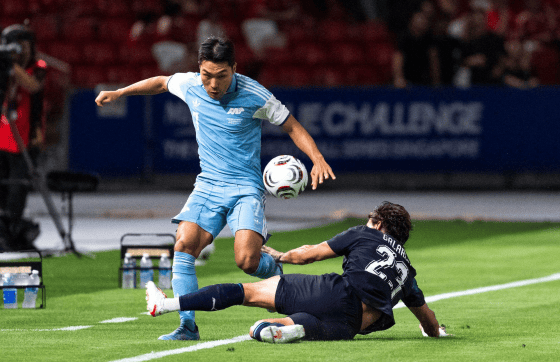
Singapore may have fallen 4-1 to Paraguay in the opening match of the Mizuho Blue Challenge – The Kallang Football Series Singapore, but the scoreline only tells part of the story.
For a spell in the first half, the Lions showed they could compete with a side that had recently secured its return to the FIFA World Cup. They moved the ball with confidence, found opportunities down the flanks and, after falling behind early, produced a well-worked equaliser through Song Uiyoung.
But against opponents of Paraguay’s quality, promising spells need to count for more. The visitors made Singapore pay for lapses at key moments, then raised the intensity after the break to pull away.
Singapore started the match with the opportunity to test themselves against a higher level of opposition, and Paraguay wasted little time in showing the threat they carried. Gustavo Caballero opened the scoring in the seventh minute, finishing a cross into the box to give the visitors an early advantage.
The Lions gradually found their way into the game. Their attempts to create openings down the flanks initially lacked the quality needed to trouble Paraguay consistently, but the approach began to pay off as the half progressed.
In the 30th minute, Singapore found the breakthrough they had been working towards. Kyoga Nakamura delivered the assist, and Song Uiyoung finished to bring the home side level at 1-1.
It was a deserved reward for a spell in which Singapore had begun to find more purpose in possession and looked increasingly capable of troubling the Paraguayan defence.

There was another opportunity soon after. Ryhan Stewart made good progress down the flank before laying the ball across for Ilhan Fandi. Ilhan turned his marker, but the ball became caught under his feet, allowing Paraguay to escape. It was a significant let-off for the visitors, and a reminder that Singapore needed to make the most of the chances they were creating.
The Lions were made to pay just before half-time. A series of quick passes opened up the Singapore defence, allowing Mauricio Magalhaes to slot home in stoppage time and restore Paraguay’s lead at 2-1.
It was a painful moment for Singapore, particularly after the momentum they had built. Instead of going into the break on level terms, they were once again chasing the game.
Paraguay returned with greater urgency after the restart. Caballero scored his second of the night in the 53rd minute to make it 3-1, giving the visitors breathing room and shifting the balance of the contest.
The Lions continued to work, but the challenge became increasingly difficult as Paraguay introduced fresh players and lifted the tempo. Substitute Julio Enciso added a fourth in the 82nd minute, underlining the difference in depth and intensity between the two sides.
Singapore goalkeeper Izwan Mahbud was called upon to make a series of saves as Paraguay pushed for more, helping to keep the final score at 4-1.

The result was not what Singapore wanted, but there were genuine positives to take from the first half. The Lions showed that they could keep possession, find spaces between the lines and use the pace of their wide players to create danger.
Paraguay head coach Gustavo Alfaro was complimentary about what he saw. He noted that Singapore tried to retain possession rather than simply give the ball away, and that their attacking players were able to find pockets of space between the lines.
He also recognised the threat posed by Singapore’s wingers, particularly when the team found passing lanes to release them.
But Alfaro felt his side had made the necessary adjustments after the break. By being more patient in possession and playing passes behind Singapore’s midfield, Paraguay were able to create more problems. The introduction of players with greater intensity then made it harder for the Lions to maintain the pace of the contest.
That assessment was echoed by Singapore head coach Gavin Lee, who felt his side had managed the game well during the period between Paraguay’s opening goal and their second just before half-time.
There was a spell when Singapore had momentum, he said, and the team could have punished Paraguay further. But at this level, small mistakes can have significant consequences.

Lee had also anticipated two major challenges: dealing with the tempo of a team playing at the highest level, and sustaining that intensity for the full 90 minutes. The second half showed just how difficult that would be.
The coach was careful not to use the opposition’s quality as an excuse for the goals conceded. He acknowledged that some of the mistakes were not good enough, and that the team would need to examine them honestly.
For Lee, the challenge is finding solutions rather than dwelling on frustration. Singapore have limited time together as a national team, making every opportunity to learn against stronger opposition valuable.
The coach also highlighted the importance of staying together when the pressure rises. Against a side of Paraguay’s quality, the Lions were always going to face difficult spells. Their response as a team, particularly when mistakes began to creep in, was something Lee wanted to build on.
There is also a clear difference between knowing what needs to improve and being able to put it right on the pitch. Singapore’s first-half performance showed that they have the technical ability and attacking ideas to trouble good opponents. The second half exposed how much work remains to make those qualities count consistently.

Kyoga Nakamura, who provided the assist for Song’s equaliser, was disappointed with the result but pointed to the team’s ability to retain possession as a positive. Ilhan Fandi was similarly focused on taking lessons from the defeat, acknowledging that he had wanted to take his own opportunity in front of goal.
The next test will come quickly. Singapore face Brazil on Tuesday, another opportunity to measure themselves against elite opposition. The task is not simply to compete for a period, but to carry their best football across the full match.
The 4-1 defeat is not a reason to dismiss the progress Singapore showed. But it is a reminder of the gap that remains — and of the work required to close it.
Japan and Brazil set for World Cup rematch as Moriyasu prepares for farewell
Japan and Brazil meet at the National Stadium on Saturday in a highly anticipated rematch of their FIFA World Cup 2026 encounter, with the occasion carrying extra significance for Japan.
Earlier in the day, Japan head coach Hajime Moriyasu announced that the matches in Singapore would be his last in charge of the national team, bringing an end to an eight-year spell at the helm.
It gives Saturday’s contest an added emotional dimension. Moriyasu will want to leave the national team with a strong performance, but his focus remains firmly on the challenge in front of him: taking on one of the world’s most formidable football nations.
Japan have made significant strides in recent years, and their recent meeting with Brazil at the World Cup showed they could compete with the South American side. But Moriyasu knows there is still work to do.

“At the World Cup, we were reminded that there is still a gap we need to close,” he said. “However, rather than looking up to our opponents, we want to face them as equals and fight for victory. I believe we have every chance of winning.”
Japan’s preparations have centred on playing with greater aggression in attack. Moriyasu wants his players to make more forward runs, increase the intensity of those movements and create more opportunities to shoot and score.
While the immediate objective is to win, he also sees the match as part of the longer-term development of Japanese football.
“We will give our very best as a united team, hoping to make everyone supporting us from Japan, Singapore and across Asia feel a sense of both Japanese pride and Asian pride,” he said.

Brazil head coach Carlo Ancelotti is under no illusions about the challenge Japan will present. He described Japan as a highly competitive opponent, pointing to the improvements they have made in recent years and the difficult test they provided Brazil at the World Cup.
“Japan are a very competitive opponent. They have improved a lot in recent years and competed very well against us at the World Cup,” he said. “It was a difficult game, and tomorrow will be difficult too because they are very well organised both defensively and offensively.”
Ancelotti also praised Moriyasu’s work with the Japanese national team, noting that the coach had been given time to build a strong and well-organised side.
He believes Moriyasu has the qualities to coach and manage a team anywhere in the world — a significant endorsement as the Japanese coach prepares to step away from the role.
For Brazil, the match is more than a friendly. Ancelotti sees competitive fixtures against strong opponents as important opportunities to improve, while also giving younger players valuable experience.
That focus on developing the next generation is an important part of Brazil’s current plans. Ancelotti has spoken about the potential he sees in the younger players coming through and the importance of giving them opportunities to prove themselves.
Saturday’s match should therefore offer an intriguing mix of experience and renewal: a Japan side looking to make a statement in their coach’s final appearance, against a Brazil team continuing to build towards its next competitive challenges.

For Moriyasu, the occasion is about more than the result. Eight years in charge have given him time to shape the identity of the Japanese team, and his final matches in Singapore provide an opportunity to bring that chapter to a close in front of supporters in the region. For Brazil, it is another chance to test themselves against a side Ancelotti clearly respects.
And for fans at the National Stadium, the prospect is an appealing one: two teams with recent World Cup history, a rivalry renewed, and a Japanese side determined to give its departing coach a memorable send-off.
Photo Credit: The Kallang
Mizuho Blue Challenge – The Kallang Football Series Singapore rolls out as follows:
14 November 2026
Japan vs Brazil
17 November 2026
Singapore vs Brazil
Japan vs Paraguay
Venue: National Stadium at The Kallang
Ticket sales: From 4 September 2026, 12pm SGT
Opening match tickets: From S$28
17 November: Doubleheader on a single ticket
ShopeeVIP users will also have access to exclusive ticket opportunities through Shopee, the Official Partner of the tournament. More information available on The Kallang

