
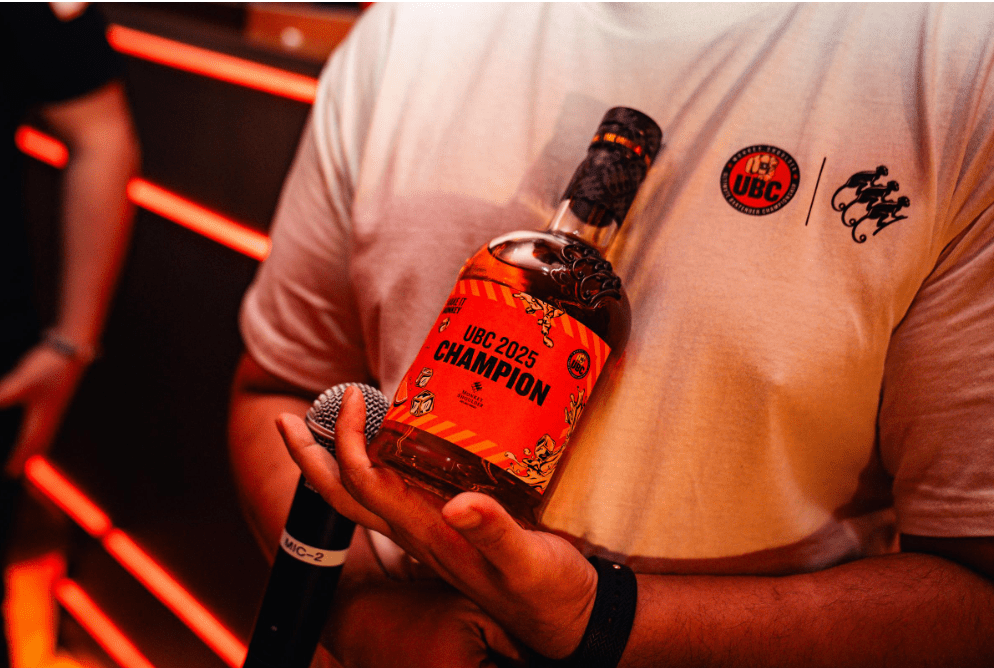
From 10th to 12th October, Southeast Asia’s brightest bartenders gathered in Tokyo for the first-ever Monkey Shoulder Ultimate Bartender Championship (UBC) Regional Finals: a high-energy showdown celebrating skill, creativity, and the pure craft of hospitality. From the first shake to the final pour, this wasn’t about smoke or spectacle, but about precision, rhythm, and heart: the “skills that pay the bills.”
After months of national rounds across 21 countries and more than 8,000 competitors, four regional champions, each embodying the spirit of their home bars and cultures, took the stage to represent Southeast Asia, including Yesaya Rotinsulu, Head Bartender at 8Souls Jazz Club, (Jakarta) and David Abalayan, Bar Manager at No Entry Cocktail Club, (Manila), who joined Malaysia’s Ivon Soon (Enso Izakaya & Bar, Kuala Lumpur), and Singapore’s Wong Wee Siong, Head Bartender at The Lobby Bar, The Singapore EDITION, who ultimately clinched the regional title in Tokyo.
We caught up with Yesaya and David to talk about their journeys, inspirations, and what it means to represent their countries in one of Asia’s most anticipated competitions. Read the interviews in full below:
Yesaya Rotinsulu (Jakarta)

What’s The Plan Please: How does it feel to represent your country at the first-ever Monkey Shoulder UBC Regional Final in Tokyo?
YESAYA: It’s honestly surreal. Representing Indonesia on an international stage, especially the first-ever UBC Regional Final in Tokyo, feels like carrying the energy of every bar I’ve ever worked behind. It’s not just my story; it’s the story of the Indonesian bartending scene that’s been growing, evolving, and finding its own identity. I’m proud and grateful to be a small part of that momentum.
What’s The Plan Please: What was the most challenging part or highlight of your national competition, and how did you overcome it?
YESAYA: The most challenging part was balancing creativity with clarity—making sure my concept didn’t just sound interesting, but also connected emotionally and tasted great. I overcame it by going back to basics: telling a story that was real to me and reflected who I am behind the bar. Once I focused on authenticity rather than perfection, everything fell into place.
What’s The Plan Please: Monkey Shoulder focuses on “skills that pay the bills.” Which skill do you think is your strongest going into Tokyo?
YESAYA: Adaptability. In bartending, every crowd, every night, every bar energy is different. Being able to read people, adjust the pace, and still deliver consistency is my strongest skill. It’s not just about mixing drinks—it’s about creating moments.
What’s The Plan Please: How did you prepare—mentally and technically—for the Regional Final? What is something about the demands of bartending that regular people don’t realise?
YESAYA: Mentally, I was grounding myself—less overthinking, more flowing with the experience. Technically, I’m refining every detail: from flavor balance to timing and presentation. What most people don’t realize is how much bartending demands emotional endurance. You’re performing, listening, creating, multitasking—all while staying calm and hospitable. It’s both art and stamina.
What’s The Plan Please: What do you hope people watching the competition will take away about bartenders from your country and bartending culture?
YESAYA: That Indonesian bartenders have soul. We mix culture, creativity, and community in everything we do. Our bars are not just places to drink—they’re spaces of storytelling, hospitality, and warmth. I want people to feel that spirit when they see us on stage.

What’s The Plan Please: Beyond the competition, how has the UBC experience shaped you as a professional and as part of the wider bartending community, and how do you hope it affects your life or reputation?
YESAYA: UBC taught me humility and growth. It reminded me that bartending isn’t a solo act—it’s a community effort. Winning isn’t just about a title; it’s about lifting others, sharing knowledge, and representing your country with pride. It’s made me more aware of the responsibility to inspire the next generation of bartenders back home.
What’s The Plan Please: After nearly a decade of UBC attempts, what finally clicked for you this year?
YESAYA: Letting go of the pressure. In previous years, I tried too hard to impress. This year, I just wanted to express myself. I built my concept around honesty, not perfection—and somehow, that authenticity resonated.
What’s The Plan Please: You’ve described your win as “a new responsibility.” How do you plan to give back to the Indonesian bar community?
YESAYA: I want to share everything I’ve learned—through workshops, mentorships, and collaborations that connect senior and younger bartenders. We have so much talent in Indonesia; it just needs more platforms and guidance. If my experience can help open even one new door for someone else, that’s the real reward.
What’s The Plan Please: Music is central at 8Souls Jazz Club. How does the vibe of a venue like that influence your bartending style?
YESAYA: Music shapes the rhythm behind the bar. At 8Souls, jazz isn’t just background—it’s energy, mood, and flow. It teaches you tempo: when to slow down, when to build tension, when to release. My bartending style follows that same beat—smooth, soulful, and always in tune with the room.
David Abalayan (Manila)

What’s The Plan Please: How does it feel to represent your country at the first-ever Monkey Shoulder UBC Regional Final in Tokyo?
DAVID: It feels amazing to represent the Philippines on such a big stage. Competing at the first Monkey Shoulder UBC Regional Final in Tokyo is something I’ll always be proud of. I’m very excited to not only showcase my own skills but also about representing the creativity, warmth, and energy of Filipino bartenders. Our community is full of passion and drive, and I want to show that we can stand tall among the best in Asia.
What’s The Plan Please: What was the most challenging part or highlight of your national competition, and how did you overcome it?
DAVID: The national competition pushed every part of me. Each challenge tested a different skill, from speed to accuracy to creativity, but the Round Building challenge was the hardest. It demanded precision and composure while moving fast under pressure. I overcame it by training until everything became second nature. When the moment came, I trusted my preparation and stayed focused on enjoying the process rather than stressing about the outcome.
What’s The Plan Please: Monkey Shoulder focuses on “skills that pay the bills.” Which skill do you think is your strongest going into Tokyo?
DAVID: My strongest skill is precision. I have learned that bartending is about consistency and control, especially when things get busy. Every movement behind the bar matters. Being precise keeps everything flowing smoothly and ensures every guest gets the same great experience. That discipline is what “skills that pay the bills” means to me: mastering the essentials and delivering them perfectly, every single time.
What’s The Plan Please: How are you preparing mentally and technically for the Regional Final? What is something about the demands of bartending that regular people don’t realise?
DAVID: My preparation is all about balance. Mentally, I am focusing on staying calm, confident, and positive, especially under competition pressure. Technically, I’m refining every step of my workflow so that it becomes instinctive. Many people don’t realise how demanding bartending can be. It takes physical stamina, technical skill, and emotional focus all at once. You’re creating moments for people, and that takes real attention and energy.
What’s The Plan Please: What do you hope people watching the competition will take away about bartenders from your country and bartending culture?
DAVID: I hope people see how passionate and hardworking Filipino bartenders are. We might not always have the fanciest bars or tools, but we make the most of what we have with creativity and heart. Our bartending culture is built on warmth and resilience, and that’s something I want to represent in Tokyo.

What’s The Plan Please: Beyond the competition, how has the UBC experience shaped you as a professional and as part of the wider bartending community, and how do you hope it affects your life or reputation?
DAVID: Monkey Shoulder UBC has helped me grow in every way. It taught me the importance of balance, flavour, attitude, teamwork, and consistency. Competing alongside so many talented bartenders has inspired me to keep improving and to share what I’ve learned with others. It’s also made me more aware of how big and connected the bartending community in Asia is. Being part of that network motivates me to contribute and help raise the standard of our craft.
What’s The Plan Please: Your victory in Manila came down to speed and precision. How did you train to achieve that level of sharpness?
DAVID: I trained by building structure and discipline into my daily routine. Every day I practised timing, consistency, and workflow, paying attention to even the smallest details. I recorded my runs, reviewed my performance, and refined every motion until it felt natural. That repetition built both speed and control. Winning in Manila proved to me that hard work and consistency really do pay off.
What’s The Plan Please: No Entry Cocktail Club has a reputation for creativity. How does that environment push you as a bartender?
DAVID: Working at No Entry is both inspiring and challenging. We’re encouraged to think differently, to experiment, and to express our personalities through our drinks. That kind of creative environment pushes me to grow constantly. It reminds me that bartending isn’t just about skill, but also about imagination and connection. Monkey Shoulder’s playful, mixable spirit fits perfectly with that mindset: serious about quality, but never taking yourself too seriously.
What’s The Plan Please: When you’re not competing, what drink do you enjoy making the most for your guests and why?
DAVID: I enjoy making a Ramos Gin Fizz. It’s a classic that requires patience, technique, and attention to detail. I like it because it reminds me of what bartending is all about. There’s a quiet satisfaction in getting it right and seeing your guest enjoy that first sip. It’s a simple reminder of why I love what I do.
Read part 1 of our interview coverage, where we spoke to champion Wong Wee Siong (Singapore), regional finalist Ivon Soon (Malaysia), and Brand Spokesperson Tao (Thailand)
The first ever Monkey Shoulder Ultimate Bartender Championship Regional Finals took place in Tokyo from 10-12th October alongside with the DMC World DJ Championships. More information available here
 WhatsThePlanPlease